
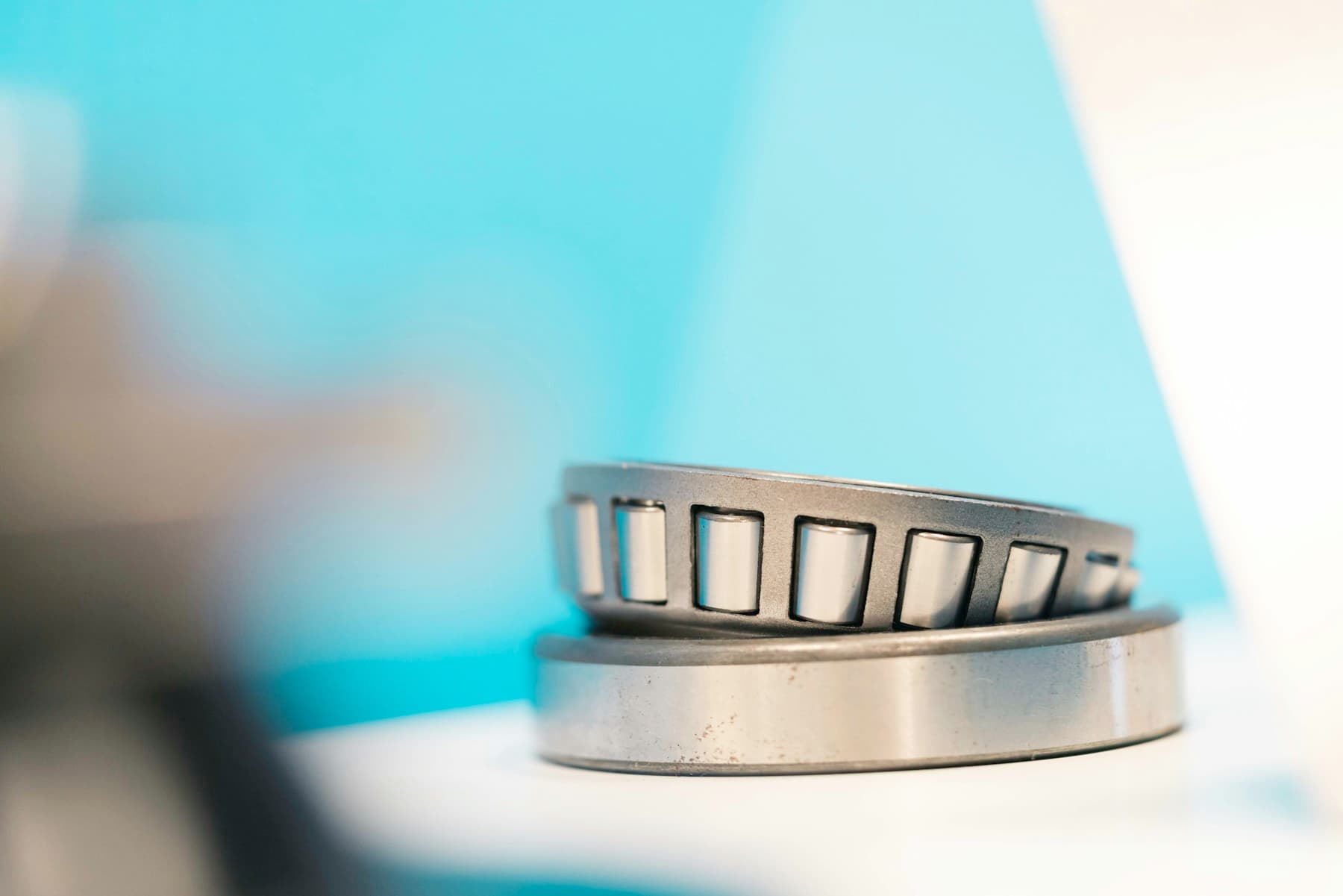
Single Row Tapered Roller Bearings
One row of tapered rollers with a separable cup and cone. It takes radial load together with thrust in one direction only, so it is always fitted opposite a second bearing that handles thrust the other way. SES holds the range as an authorised SKF distributor, covering bore range About 15 mm to 1200 mm; dimension series Metric ISO 355 and inch ANSI/ABMA; contact angle Commonly 10 to 16 degrees, steeper on thrust-heavy series; cage Pressed steel standard; machined or polymer on selected sizes. Executions include metric single row bearings to ISO 355, inch single row bearings to ANSI/ABMA series, cap-sealed executions for hub and wheel duty, flanged outer ring executions for through-bored housings, among others. It is specified most often into bevel pinion shafts in conveyor and stacker-reclaimer gearboxes and wheel hubs on tippers, dumpers and yard transfer vehicles. Every part is genuine SKF through official channels, with designation, specification and options confirmed against your duty before it ships — supplied from Kolkata and our branch network, with breakdown cover that does not sit in an inbox.
Send an enquiry
Check Price & Availability.
Give us the size or the failed part — we reply on WhatsApp.
Trusted across Metals & Energy
Supplying India’s Industrial Names.
From integrated steel plants to power utilities and EPC majors — the works that cannot afford a counterfeit part specify through SES.





















Load
Radial + axial, single direction
Arrangement
Always paired — back-to-back or face-to-face
Mounting
Cup and cone fitted separately
Setting
End float or preload set by the fitter
Where it runs.
You will find Single Row Tapered Roller Bearings in the parts of a plant where this particular duty actually occurs. In practice that means bevel pinion shafts in conveyor and stacker-reclaimer gearboxes, wheel hubs on tippers, dumpers and yard transfer vehicles, vertical spindle mixer and agitator shafts in agro plant, and equally bucket elevator head shafts in plummer block arrangements, paper machine and calender roll journals, belt-driven fan shafts where drive pull and duct thrust act together. What links them is the duty rather than the machine name — load: Radial + axial, single direction. If your installation is not on that list it matters less than you would think: the operating condition decides the specification. Send us the load, the speed, the running temperature and the environment it runs in, and we will match it to the right execution in the SKF range and confirm what is in stock.
Specify it against the duty.
Specification here follows the operating condition, not the catalogue. Wide bearing spacing on a shaft that runs hotter than the housing around it — Face-to-face arrangement, so thermal growth opens the setting. Back-to-back on a long hot shaft preloads itself and the bearing cooks from the inside. Overhung pulley or a stiff bevel pinion that must not tilt under load — Back-to-back arrangement. The effective load centres sit further apart than the bearings themselves, which is where the tilting stiffness comes from. The outer ring is creeping in a housing that has been bored out over past repairs — A tighter cup fit and a clamped end cover, not a heavier bearing. A creeping cup wears the housing oval and no bearing you fit next will survive. Where two of those apply at once, specify for the harsher of the two — under-specifying is what puts the part back on the bench a month later. Send us the duty and we will confirm the execution.
Ordering this from SES.
Cups and cones are ground as pairs at the works. When you strip a machine, keep each cup with its own cone and paint-mark them before they go in the tray — a swapped pair runs on the wrong contact pattern and steps the large rib inside a few weeks.